Kahani · Under the Loupe
A diamond is adiamond. Full stop.
July 2026 · 6 min read
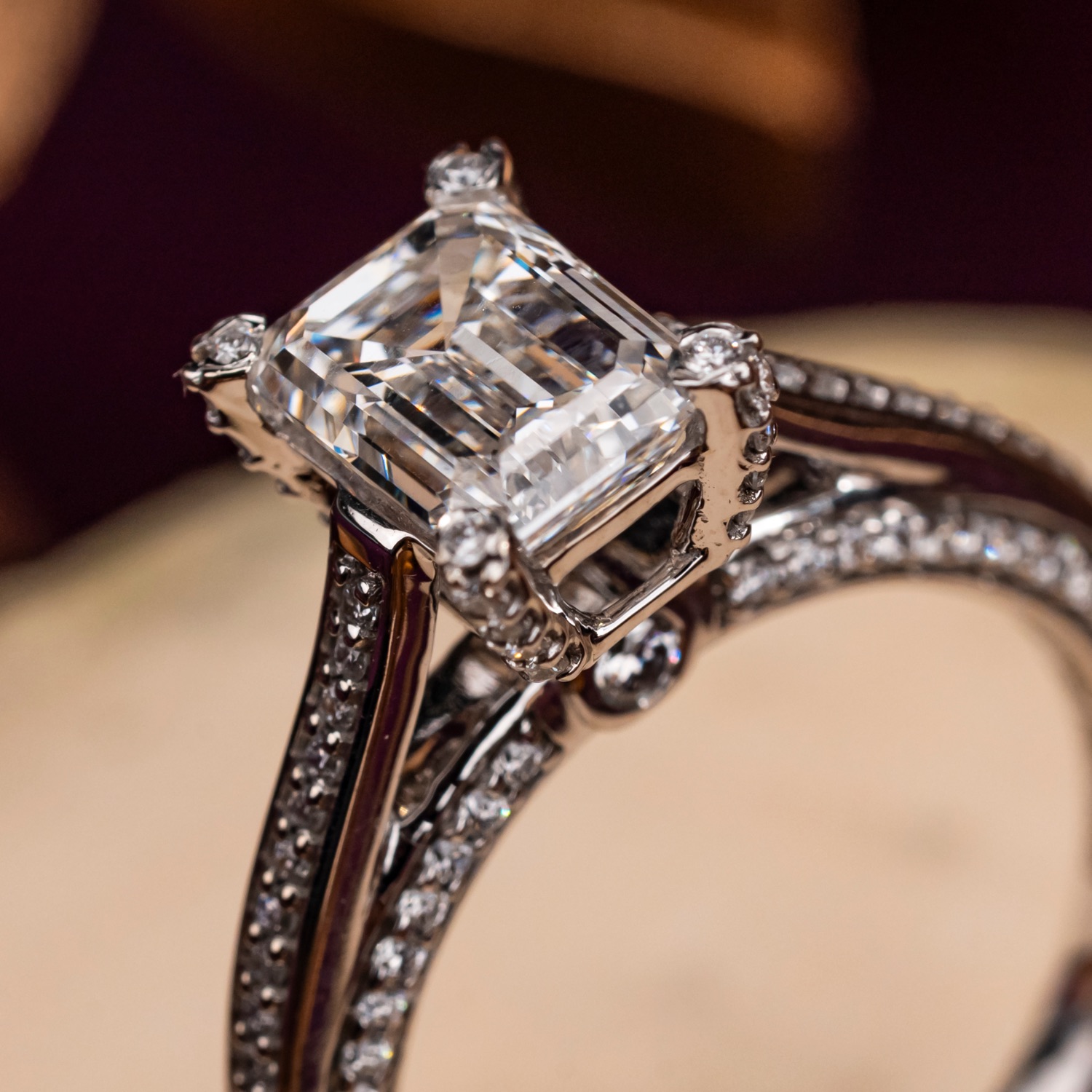
There is a question we hear at the store almost every week, asked quietly, as if it might be impolite: “But is it a real diamond?”
It is a fair question. It is also the wrong one, and the difference matters, because the answer changes how you buy, what you pay, and what you feel every time the stone catches light on your hand.
The chemistry does not negotiate
A diamond is carbon atoms arranged in a cubic crystal lattice. That is the entire definition. Not “carbon arranged underground,” not “carbon arranged a billion years ago.” Carbon, in that lattice, is a diamond, the way ice from your freezer and ice from a glacier are both, indisputably, ice.
A lab-grown diamond has the same hardness (a perfect 10 on the Mohs scale), the same refractive index (the fire), the same dispersion (the rainbow flashes), and the same thermal behaviour as a mined stone. Under a jeweller's loupe, under a microscope, on your finger: identical. Gemological institutes certify them with the same 4Cs grading they apply to mined stones.
The only instrument that can reliably tell them apart is a machine built specifically to detect how the stone grew, not what it is.
What actually differs
Three things, honestly stated. Origin: one grew in the earth over roughly a billion years; the other grew in a chamber over several weeks, from a diamond seed, by the same physics. Price: lab-grown stones typically cost significantly less for the same size and grade, which usually means you wear a better stone, not a cheaper one. And provenance: a lab-grown diamond's story is fully traceable, from seed to setting. No ambiguity, no uncomfortable questions.
The question worth asking
So instead of “is it real?”, ask “what do I want this stone to say?” If the answer involves size, fire, clarity, conscience, and a story you can tell out loud from beginning to end, the lab-grown answer is not the compromise. It is the upgrade.
Come see one under the loupe. Bring your scepticism. It is welcome here, and it usually leaves lighter than it arrived.
Keep reading
All storiesThe 4Cs, read as a love language
Cut, colour, clarity, carat. The grading system everyone quotes and few explain. A translation, from technical to human.
Why we built a store for conversations, not transactions
A note from the desk at Jayanagar, on slowness, trust, and why our first question will never be your budget.